Chair:
Nikolaos Vernadakis, Professor, Department of Physical Education and Sport Science, Democritus University of Thrace
Maria Giannousi, Assistant Professor, Department of Physical Education and Sport Science, Democritus University of Thrace
Abstract:
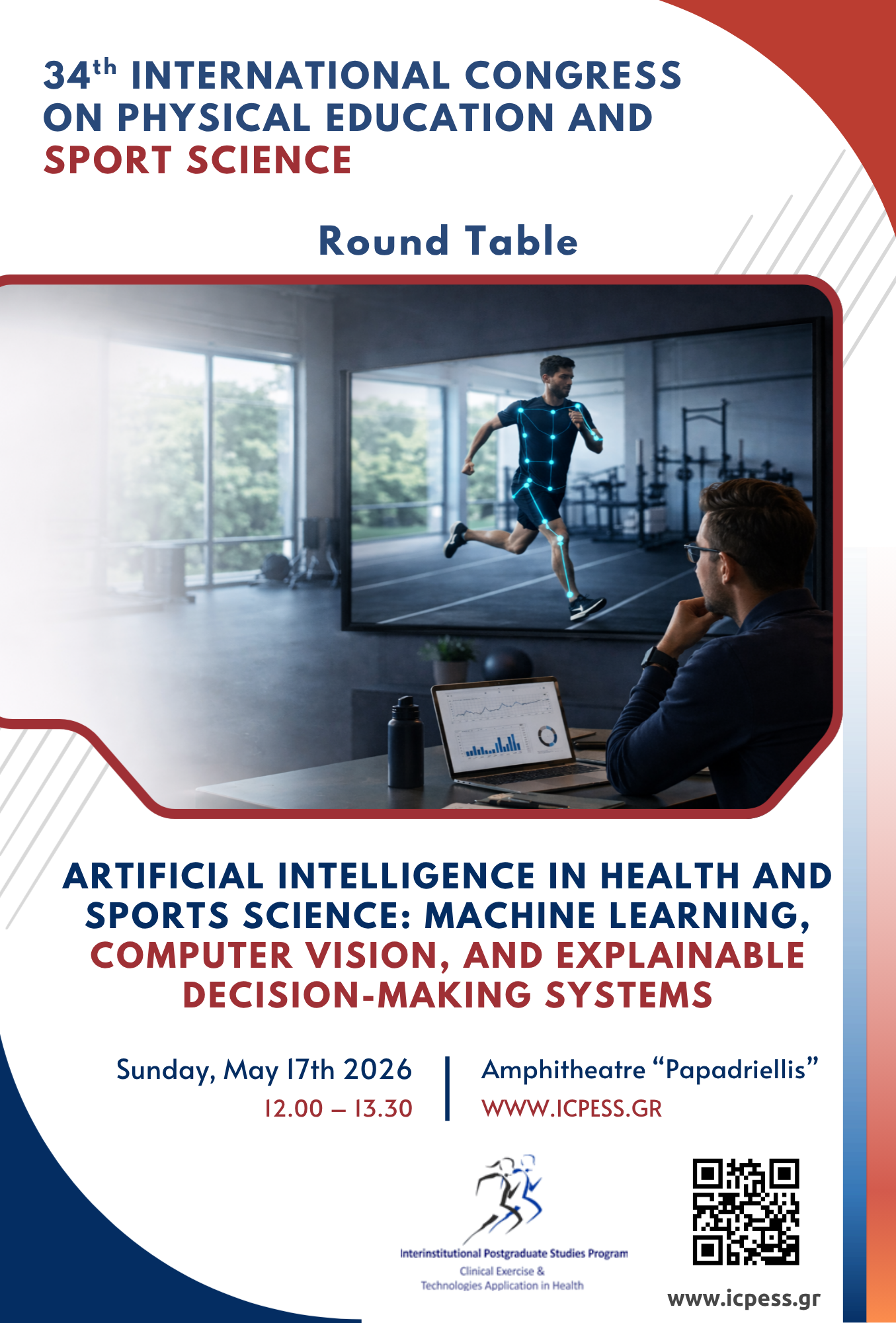
This round table explores contemporary applications of Artificial Intelligence (AI) in health and sports science through three equal and interrelated thematic axes, highlighting the transition toward intelligent, proactive, and explainable decision-support systems.
The first axis addresses the fundamental principles of machine learning, with emphasis on supervised learning and model interpretability as essential factors for trust, transparency, and adoption in clinical and applied environments.
The second axis focuses on deep learning and computer vision for analyzing human motion and behavior, including human and object detection, pose estimation for fall prediction, human activity recognition, and facial analysis for emotion and fatigue assessment through landmark-based methods.
The third axis examines the transformation of sports science through AI, where the integration of computer vision, wearable technologies, and generative AI enables proactive performance monitoring, injury prevention, and enhanced coaching workflows.
Overall, the panel highlights a unified human–machine collaboration framework in which Artificial Intelligence supports rather than replaces scientific and professional decision-making.
Speakers:
George Panayiotou, Associate Professor of Sport and Exercise Physiology, School of Sciences, Department of Life Sciences, European University Cyprus, Nicosia, Cyprus
George Panagiotou is an academic at the rank of Associate Professor and serves as Coordinator of the Exercise, Health and Human Performance Laboratory as well as the Master’s Programme in Applied Sport Science at the Department of Life Sciences, Faculty of Pure and Applied Sciences, European University Cyprus. He specializes in the assessment and analysis of athletic performance in football and in high-performance sport more broadly. Over the past 20 years, he has collaborated with numerous football clubs in Cyprus and abroad. He has served as Exercise Physiologist and Director of Medical and Scientific Staff at AEL Limassol (2008–2014) and at AC Omonia Nicosia (2018–2019).
Ioannis Kansizoglou, Assistant Professor at the Department of Occupational Therapy, School of Physical Education, Sport Science and Occupational Therapy, Democritus University of Thrace
Ioannis Kansizoglou is an Assistant Professor at the Department of Occupational Therapy, School of Physical Education, Sport Science and Occupational Therapy, Democritus University of Thrace. He received his Diploma in Electrical and Computer Engineering from the Aristotle University of Thessaloniki in 2017 and his Ph.D. in deep representation learning and affective computing from the Laboratory of Robotics and Automation, DUTH, in 2021. He has previously served as a Postdoctoral Researcher at the same laboratory, contributing to projects funded by the European Commission and the Greek Government. His research interests include assistive technologies, affective computing, human–computer interaction, and robotics.
Christos Kokkotis, Assistant Professor at the Department of Occupational Therapy, School of Physical Education, Sport Science and Occupational Therapy, Democritus University of Thrace
Dr. Christos Kokkotis is an Assistant Professor at the Department of Occupational Therapy, School of Physical Education, Sport Science and Occupational Therapy, Democritus University of Thrace. He holds a PhD in Machine Learning applications in Quality of Life from the University of Thessaly. His research focuses on motion analysis, time-series data, and the development of machine learning and deep learning models in healthcare and rehabilitation. He has worked on applications including knee osteoarthritis prediction, stroke recovery, and ACL rehabilitation monitoring. He has also contributed to research projects at CERTH within the OActive and SafeACL programs. Dr. Kokkotis is actively involved in Horizon-funded projects and his work aims to bridge AI and clinical practice through interpretable and data-driven solutions.